Stable-release retail decision record
Boutique and gift shop POS evaluation
Posnic v1.3.0 has inspectable variant, item, generic barcode, supplier, stock, receiving, customer, sale, return, receipt, report and backup paths. It is not presented here as a native size-by-colour matrix, gift-card ledger, hamper engine, occasion-reminder platform, toy-compliance record or proof of a completed shop day.
Reviewed 18 Aug 2026 at archived source commit b531ef4.
Inspect the existing interface before testing a boutique
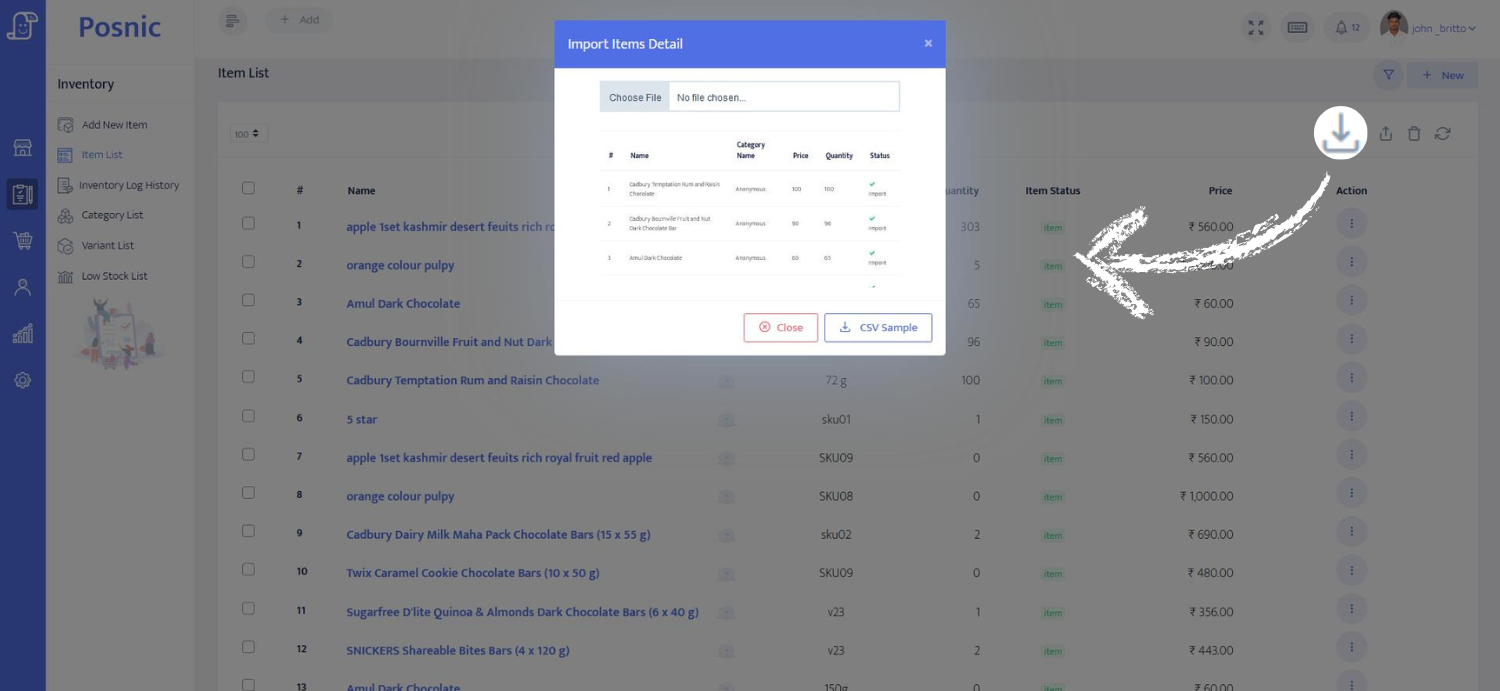
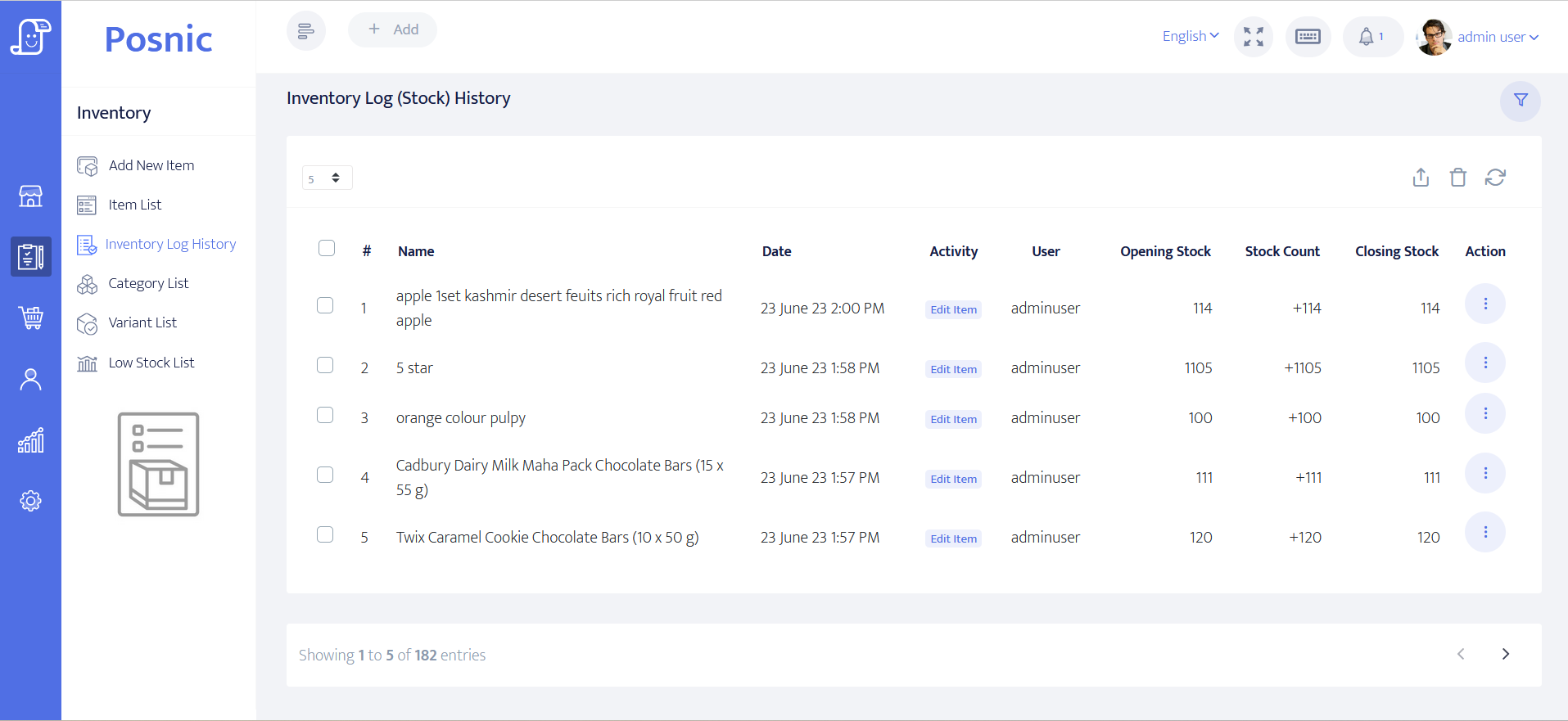
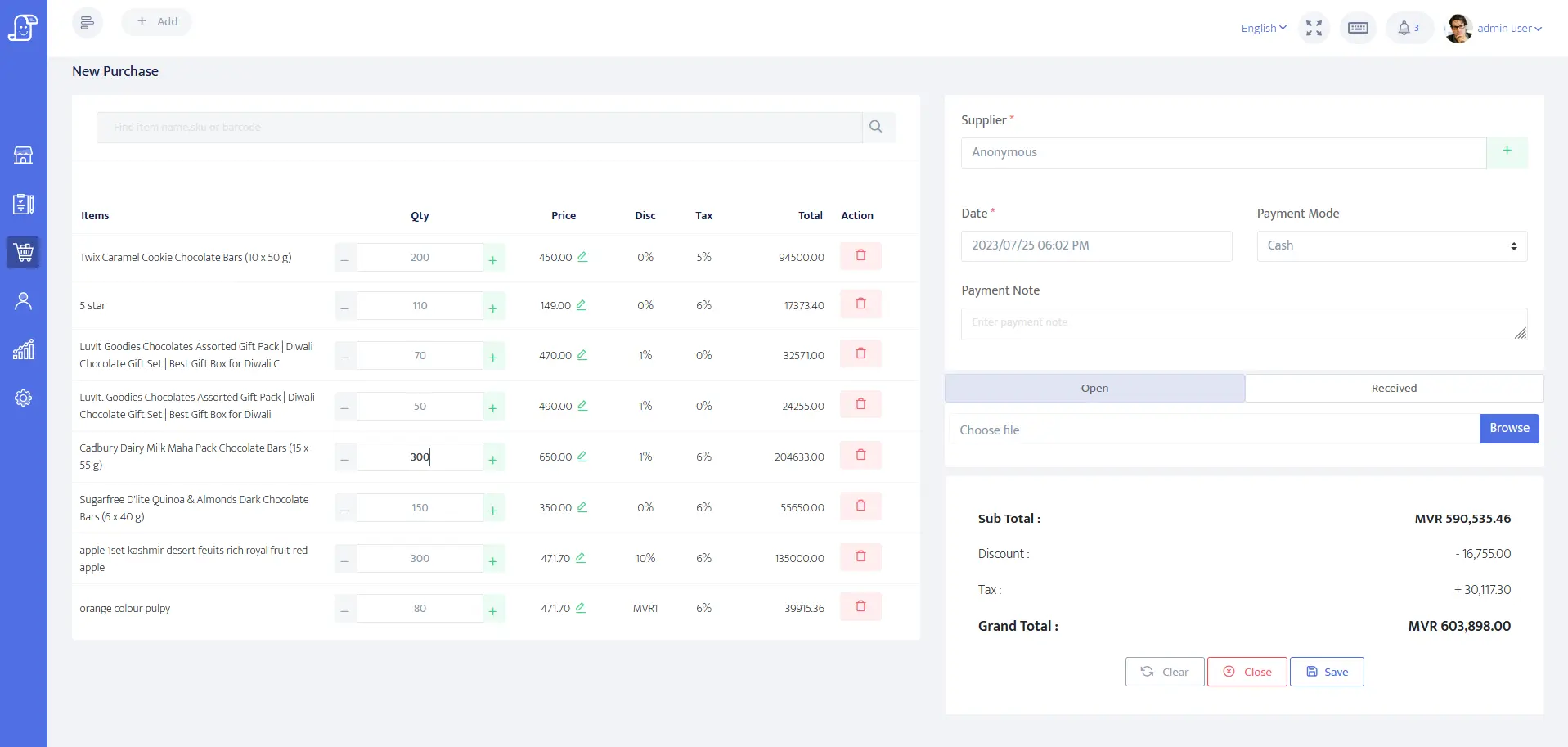
These existing Posnic captures use sample retail data. They show visible import, stock-history and purchase-entry surfaces; they are not a boutique customer result, physical count, supplier reconciliation or proof that a variant catalogue imports correctly.
What the tagged public source establishes
The evidence comes from the exact public source used for the stable release, selected automated checks, lockfile audits and direct inspection. A source path proves less than a configured counter, so each result has a boundary.
| Area | Evidence at the pinned commit | Boundary to test |
|---|---|---|
| Variant entry | The item interface selects one variant definition and loops over selected values. Each value can become a separate item named from the base item and value. | No native two-dimensional matrix, combination generator, parent-child roll-up or matrix stock view was established. |
| Variant item fields | Selected values can receive separate SKU, barcode, MRP, cost, selling price, quantity, unit and discount fields. | Prove naming, duplicate handling, combinations, edits, returns and reports with the real catalogue. |
| Stock and suppliers | Generic category, supplier, tracked-stock, stock-log, receiving and receiving-return paths exist and their selected suites passed. | No physical delivery, shelf count, supplier statement or seasonal reconciliation was completed. |
| Customer records | The customer model includes loyalty, totals, notes, tags and communication-preference fields. | No campaign engine, occasion reminders, consent proof, unsubscribe audit or privacy compliance was established. |
| Sale and return paths | Desktop sale-call, receipt and report checks passed; API sale, return and report paths exist. | Six selected sale-repository checks failed and no complete shift, payment settlement or local invoice was accepted. |
Six selected failures stay in the decision record
The selected run executed 49 API suites. Forty-eight suites passed; the sale repository suite produced six failures. These are test failures, not observed customer incidents, but they block an unqualified checkout claim.
| Failure group | Observed selected-test result | Acceptance consequence |
|---|---|---|
| Sale lookup contract | Three checks expected the repository to delegate getById and findById through the mocked model but observed no such calls. | Exercise sale retrieval, projection and populated references with retained transaction IDs. |
| Document-number fallback | Two checks expected S-DEV1-000045 but received SID-DEV1-000045. | Approve sale and fallback numbering with real branch, till, invoice and uniqueness rules. |
| QR order creation | One check expected a successful QR order result and received a false status. | Keep QR ordering outside the boutique decision unless its complete route is required and passes separately. |
The same lockfiles reported 27 npm audit findings: 16 in the desktop tree and 11 in the API tree. Severity alone is not exploitability, but remediation and qualified review remain required before production approval.
Design product identity before importing variants
A boutique may sell the same design in several sizes, colours and materials; a toy or gift shop may receive manufacturer barcodes, locally labelled items and products moving toward richer 2D symbols. Decide what a sellable item is before creating records.
| Decision | Use the reviewed Posnic path for | Keep outside until accepted |
|---|---|---|
| One sellable value | A separate item with its own name, SKU, generic barcode, price and quantity. | A matrix parent that automatically creates every size-by-colour combination. |
| Identity and barcode | Retaining an approved generic code and proving exact lookup in the configured counter. | GTIN allocation, validation, master-data ownership and 2D data processing not implemented and tested. |
| Wrapping and add-ons | A normal service or item line after tax, price, receipt and report treatment pass. | A dedicated wrapping workflow, material consumption, gift message or profitability calculation. |
| Hamper or set | Accepted individual item lines. | Component depletion, substitutions, partial returns and set rebuilding without a proved bundle engine. |
| Toy information | Generic item name, description and category where suitable. | Required age, warning, batch, recall and product-safety records without a specialist-approved source. |
GTIN management
GS1 defines GTIN as a way to identify trade items and publishes rules for deciding when a product needs a new identity. Apply the shop's approved allocation and data-ownership process; a free-text POS field is not the standard itself.
2D barcode transition
GS1's retail POS guidance covers scanner, software, data, print-quality and transition considerations. A generic barcode field and an interface screenshot do not prove 2D decoding or processing.
Customer preference fields are not marketing consent
The reviewed model contains email, SMS and WhatsApp notification booleans plus a preferred channel. The defaults are enabled, and the review did not establish a campaign engine, occasion-reminder workflow, source and timestamp of permission, notice version, withdrawal log or jurisdiction-specific consent decision.
Minimize
Collect only fields with a documented retail purpose, retention period and access owner.
Prove permission
Keep the notice, affirmative action, source, time, channel, purpose and withdrawal evidence required by the shop's applicable rules.
Separate communication
A preferred channel helps routing only after permission and suppression rules are accepted. It does not authorize a campaign by itself.
Test returns and deletion
Check how customer totals, loyalty, sale history, exports, corrections and deletion requests interact before approval.
The NIST Privacy Framework is a voluntary risk-management tool. Its profiles can help a buyer state required privacy outcomes, evaluate a product against them and record residual risks without pretending that the framework supplies local legal advice.
Ten outcomes this evidence does not prove
Complete boutique day
No opening-to-close day reconciled sales, returns, cash, provider records, tax and stock.
Multidimensional matrix
No native size-by-colour combination generator or matrix stock view was established.
Gift card or stored value
No accepted issue, redeem, refund, expiry, liability and balance workflow was established.
Gift receipt or wrapping
No dedicated price-hidden receipt, recipient return, wrapping material or gift-message workflow was established.
Hamper components
No accepted component depletion, substitution, partial-return or rebuild workflow was established.
Layaway or reservation
No complete promise, deposit, balance, status, cancellation and collection workflow was established.
Consignment
No accepted consignor ownership, settlement, return and liability workflow was established.
Seasonal sell-through
No dedicated seasonal intake, sell-through, markdown and carryover report was established.
Toy compliance
No accepted age, safety warning, batch, recall or jurisdiction-specific product record was established.
Physical counter
No scanner, label printer, receipt printer, drawer, display or payment terminal was connected.
Run one representative shop day before approval
The downloadable record leaves observation, evidence, ownership, specialist review, pass or fail and follow-up fields blank. Fill it with the shop's real variants, toys, gifts, seasonal products, suppliers, taxes, staff, devices, payment route, customer policy and recovery target.
| Stage | Run with representative evidence | Retain before approval |
|---|---|---|
| 1. Catalogue and identity | Choose multidimensional styles, manufacturer-coded toys, local gifts, services and one hamper. | Approved identity rules, field mapping, duplicate policy, unsupported combinations and specialist-owned records. |
| 2. Import and scan | Trial-import a copy and test valid, duplicate, unknown, damaged, linear and required 2D codes. | Input, rejected rows, before and after counts, timings and exact scanner configuration. |
| 3. Counter and returns | Run cash and non-cash sales, wrapping, discounts, price overrides, returns and exchanges across variants. | Transaction references, approved tax results, payment evidence, documents, permissions and exceptions. |
| 4. Supply and stock | Receive stock, return damaged stock, adjust a count and review seasonal items. | Supplier evidence, movement chain, count variance, approvals and any external analysis. |
| 5. Customer and unsupported needs | Exercise loyalty, preferences, hamper, gift card, layaway, consignment and toy records required by the shop. | Approved privacy evidence and a named external owner for every unproved workflow. |
| 6. Close and recover | Reconcile one complete day, interrupt the approved environment, back up and restore a real-sized test copy. | Close report, cash and provider evidence, restore result, elapsed time, unresolved differences and sign-off. |
Keep payment and local compliance with qualified owners
The selected tests did not connect a payment terminal or approve tax, invoicing, gift-card, toy-safety, privacy or consumer-rights rules in any jurisdiction. The business remains responsible for its local obligations and provider contracts.
Payment environment
Define which system stores, processes or transmits payment data and preserve provider settlement evidence outside an unsupported POS assumption.
Local review
Have qualified local advisers approve tax, invoice, returns, stored value, privacy, toy-safety and retention controls that apply to the actual shop.
Keep each retail question with the right owner
| Need | Use this owner | Reason |
|---|---|---|
| Boutique variants, gifts, toys, customers and acceptance | This boutique and gift shop POS guide | It owns the broad shop decision and preserves product, test, privacy and workflow limits. |
| Textile size and colour operations | Textile and garment POS evidence | It owns the deeper apparel variant, exchange and textile workflow decision. |
| General retail stock to cash | Retail billing evidence | It covers broader retail acceptance without taking over gift-specific workflow questions. |
| Barcode setup and scan procedure | Barcode setup guide | Scanner setup is a separate device and procedure decision; a stored string is not scan acceptance. |
| Exact scanners and printers | POS hardware compatibility | Physical acceptance is make, model, connection, driver, mode and counter specific. |
Boutique and gift shop POS questions
What boutique and gift-shop evidence exists for Posnic v1.3.0?
At the exact stable source commit, 51 selected desktop checks passed and 2,982 of 2,988 selected API checks passed across variant, item, stock-log, customer, receiving and sale paths. Six sale-repository checks failed. No complete boutique shift or physical device test was run.
Can Posnic manage size and colour variants?
The reviewed interface selects one variant definition and can turn several selected values into separate item records with individual SKU, barcode, price and quantity fields. It did not establish a native two-dimensional size-by-colour matrix, combination generator or matrix stock view.
Can a toy or gift shop scan product barcodes?
Posnic has a generic barcode string and barcode lookup paths, but no physical scanner was connected in this review. Test valid, duplicate, unknown, damaged, linear and required 2D codes with the exact products and scanner before approval.
Does Posnic include gift cards, gift receipts, wrapping or hamper bundles?
No dedicated gift-card or stored-value ledger, gift-receipt mode, gift-wrapping workflow or component hamper bundle was established. A tested wrapping charge can be represented as an ordinary service item, but that is not a dedicated workflow or proof of correct accounting and tax treatment.
Can customer preferences be used for occasion reminders?
The customer model contains notification booleans and a preferred communication field, but no campaign or occasion-reminder engine and no complete consent audit trail were established. Do not treat a stored preference as legal consent; define a privacy-approved process first.
Does Posnic provide seasonal sell-through and toy-compliance reporting?
Generic sales, item and stock paths can be evaluated, but no dedicated seasonal sell-through report or toy age, safety, batch and recall record was established. Keep required analysis and compliance records in an approved source until exact Posnic behavior is implemented and accepted.
A download, record request, source click or local test is not a completed shop shift, customer result, payment result, compliance result or revenue outcome.